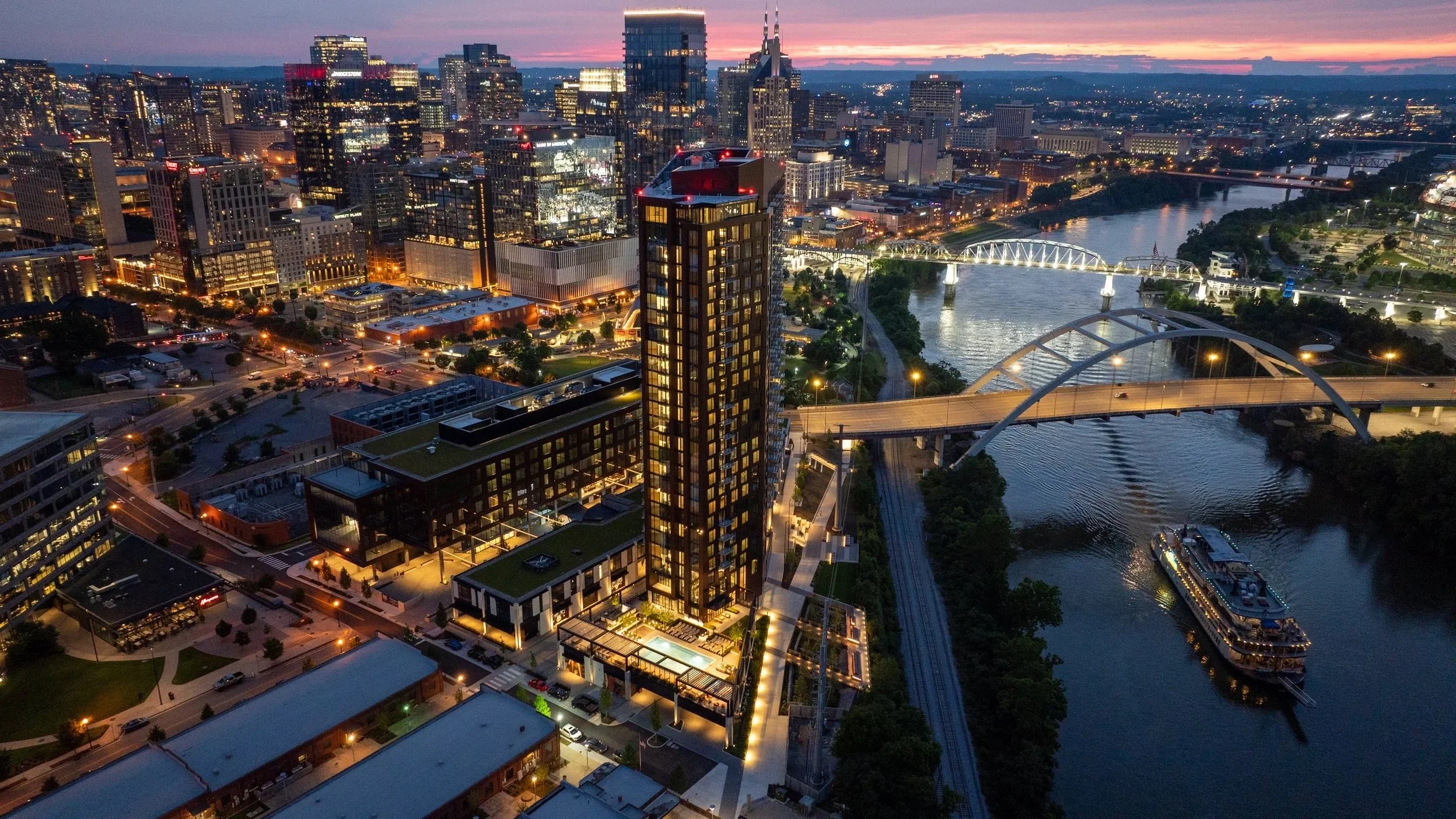
Photographers and videographers hear the same advice over and over. Shoot at golden hour. The warm, low sun softens everything, adds color, and flatters almost any subject. For portraits, landscapes, and a single building catching the last light of the day, that advice holds up. Downtown skylines are a different story.
At Nashville Drone Co, we film and photograph downtown Nashville regularly, and we have learned that the conditions that make golden hour great for a countryside or a lone building can work against you in a city full of high rises. Over time, one window of the day has become a favorite for skyline work. It arrives after the sun drops below the horizon and before the sky goes fully dark. It is called blue hour, and for downtown areas it often delivers better results.
What Golden Hour Does to a Skyline
Golden hour has a reputation for flattering light, and that reputation is earned. The sun sits low, the light travels through more atmosphere, and the result is a warm, directional glow. The trouble starts when that light meets a dense cluster of tall buildings. A downtown skyline is not a single subject. It is dozens of surfaces at different heights, angles, and materials, all competing for the same light.
Shadows split the scene
Low sun means long shadows, and in a city those shadows fall across other buildings. One tower may glow gold while the tower beside it sits in deep shade. In a single frame, the exposure range between the lit and shaded sides can be enormous. A camera that exposes for the bright building loses the dark one, and the reverse is also true.
Glass throws light around
Modern high rises are wrapped in glass, and glass reflects. At golden hour, the low sun bounces off those surfaces in unpredictable ways. Some windows blaze with glare, others mirror the sky, and some go flat and dull. The reflections change with every small move of the aircraft, which makes it hard to build a clean, consistent shot.
Light varies block by block
Streets in a downtown grid create canyons. Parts of the city receive direct sun while others never see it. The resulting patchwork of bright and dark areas can make footage look uneven, even when each individual shot seems fine on the monitor.
We should be clear on one point. We have captured beautiful photos of a single building during golden hour, and we will keep doing it. A lone tower with warm light on its face can be stunning. The challenge appears when the goal is the whole skyline and the full feel of the city.
What Blue Hour Actually Is
Blue hour is the period of twilight just after sunset or just before sunrise, when the sun sits below the horizon and the sky takes on a deep blue tone. The exact length depends on the time of year and location, but it is typically a short window, often somewhere between 20 and 40 minutes. The sky is still bright enough to hold color and detail, but the harsh direct sun is gone. That last part is what matters for city work. With no direct sun, the problems that come with golden hour disappear. There are no long competing shadows, no sharp glare off glass, and no patchwork of lit and shaded blocks.
Why Blue Hour Works So Well Downtown
The real magic of blue hour in a city comes from a balance between two light sources
The sky acts as a soft fill
The blue glow overhead lights the scene evenly, with a cool, gentle tone that lifts the shadows without creating new ones. Instead of fighting the sun, the camera works with an even base of light across the entire skyline.
The buildings turn on
As the sky darkens, the artificial lights come up. Office windows, lobby lights, rooftop accents, and architectural lighting all begin to glow. That light does something golden hour cannot. It brings out detail and shape in the structures themselves. Edges, setbacks, crowns, and facades that blend together in daylight suddenly read as separate, layered forms.
Daylight and darkness share the frame
Blue hour gives a photo the feel of both day and night at once. The sky still has color and gradient, while the city below glows with warm lights. That contrast creates depth and dimension that a flat daylight skyline rarely achieves.
Warm and cool tones play against each other
The cool blue of the sky and the warm glow of the building lights sit on opposite sides of the color wheel. That natural contrast makes the image feel rich and balanced without heavy editing. We have found that Nashville in particular comes alive once the building lights are on. The skyline has a distinctive profile, and when the lights come up against that deep blue sky, the city looks like it has a pulse.
The Technical Side of Shooting Blue Hour With a Drone
Blue hour offers beautiful light, but it also asks more of the pilot and the gear. This is where experience matters.
Exposure takes judgment
The scene contains a bright sky, glowing windows, and darker streets. Getting all three to look right requires careful exposure choices and a good understanding of the camera. Bracketing for photos and working in a flat color profile for video help preserve detail and give editors room to work.
Timing is tight
The best light lasts only a short time, and it changes quickly. A shot that looks perfect at the start of the window looks different ten minutes later. We plan flights around a set list of shots so the most important angles are captured while the light is at its best.
Stability and noise control matter
Lower light calls for slower shutter speeds or higher sensitivity, and both can reduce image quality if handled poorly. Choosing the right aircraft and settings, and keeping movements smooth, protects the final result.
Preparation makes the difference
We scout locations ahead of time, review the weather and the exact sunset timing, and plan launch and landing areas before we arrive. When the window opens, the team is ready to fly rather than figure things out.
Flying Responsibly in Downtown Nashville
Filming a major city comes with real responsibilities. Keith Stancil holds FAA Part 107 certification, the credential required for commercial drone work in the United States. Flying during twilight is permitted under current FAA rules when the aircraft is equipped with proper anti-collision lighting, and we plan every flight with that in mind. Much of the Nashville area also sits in controlled airspace, so flights require proper authorization before takeoff.
Nashville Drone Co carries liability insurance and approaches every downtown project with careful planning around people, property, and airspace.
For work that involves flying over people or moving vehicles, we also hold a FAA long term waiver and fly aircraft equipped with an ASTM-compliant parachute safety system.
Anyone hiring a drone provider for city work should ask about these credentials. The FAA’s page on commercial drone operations is a helpful place to start.
Experience That Shapes the Shot
Technical skill gets the drone into position. Knowing what the footage is for shapes every choice after that. Keith brings over two decades of professional entertainment marketing experience to his drone work. That background helps him think beyond a single pretty image. He considers how a skyline shot will be used in a tourism spot, a real estate campaign, a music video, a brand film, or a news package, and plans the flight to serve that purpose. That perspective, combined with regular work across Nashville, is how Nashville Drone Co has built a deep familiarity with the city.
We know how the skyline changes from different vantage points, where the best angles sit at different times of year, and how the light moves across downtown through the seasons. We have also worked on high-profile live event projects across Middle Tennessee, including aerial footage used in the MLS League Cup Final broadcast, which taught us how to deliver under pressure when there is only one chance to get the shot.
When Golden Hour Still Makes Sense
None of this means golden hour should be ignored. It remains a strong choice for certain subjects.
A single building or landmark that benefits from warm, directional light
Real estate and property shots where warm tones help create an inviting feel
Landscapes, parks, and riverfronts where there are few tall structures to cast competing shadows
Portraits and lifestyle content where flattering skin tones come first
The point is not that one time of day beats the other in every situation. It is that the right time depends on the subject. For a skyline, where dozens of buildings share the frame, blue hour tends to give more consistent and more dramatic results.
Tips for Planning a Blue Hour Shoot Downtown
If you are planning your own blue hour project, a few practical steps can improve the outcome.
Check the exact sunset time for your date Blue hour begins shortly after the sun drops below the horizon, so plan to arrive early and be ready.
Scout your angles in advance. Know where you want to fly and which compositions matter most.
Prepare extra batteries. Cooler evening air and a busy shot list use power quickly.
Plan for a short window. Prioritize your most important shots first and save secondary angles for the end.
Pay attention to the weather. Clear skies produce deep blue tones, while light clouds can add texture and color. Heavy overcast tends to flatten the effect.
Work with a licensed pilot. For commercial projects, hiring a certified and insured operator protects you and your project.
Frequently Asked Questions
Is blue hour better than golden hour for city photography?
For wide skyline shots with many buildings, blue hour often gives more even light and more depth. For a single building or a landscape, golden hour can still be an excellent choice.
How long does blue hour last?
It varies with the season and location, but it generally lasts a few dozen minutes. That short window is why planning matters so much.
Can you fly a drone at blue hour?
Yes, with the right credentials and equipment. Commercial pilots must follow FAA rules, which include proper lighting on the aircraft during twilight operations.
Does blue hour work for video as well as photos?
Yes. The balanced light and glowing building windows give video depth and atmosphere, which is why it works well for tourism, real estate, music, and brand projects.
Can Nashville Drone Co film downtown Nashville for my project?
Yes. We regularly film downtown Nashville for commercial, marketing, and creative projects.
See Downtown Nashville at Its Best
Golden hour earned its place in every photographer’s playbook, but a downtown skyline asks for something different. When the sky turns blue and the city lights come on, Nashville takes on a depth that midday and golden hour light rarely match. If you are planning a project that features the Nashville skyline, Nashville Drone Co can help you capture it at the right moment. Reach out at info@nashvilledrone.co to talk through your idea and timeline.